
|
|
 |
Custom Page 2 |  |
 Home Page |
Articles and Anarchist Humor |
Anarchists In History |
Contact Page Home Page |
Articles and Anarchist Humor |
Anarchists In History |
Contact Page |
|
Custom pages can be used for any kind of content and are a great way to add additional information to your site. |
||
| Emma Goldman
Biography Emma Goldman went from Russia to the United States in 1886, when she was seventeen, she married young and unhappily, and joined the many Jewish immigrants who worked in the garment-makers' sweatshops. Settling in New York, she came under the influence of Johann Most, and was converted to anarchism. She broke with Most in 1892 because he criticised the attempt assassination of Henry Frick by her companion Alexander Berkman, and in her own right became a noted anarchist orator, and a defender of women's rights, birth control and free speech. In 1919 she was deported to Russia, where she became bitterly disillusioned with the Bolshevik regime, leaving Russia in 1921 with the personal mission of exposing the dictatorship to the world. The rest of her life was spent wandering between England, Canada (where she established a residence in Toronto) and Spain during the Civil War. Her autobiography, Living my Life, reveals an intensely ego-oriented personality. Reading from My Further Disillusionment with Russia It is now clear why the Russian Revolution, as conducted by the Communist Party, was a failure. The political power of the party, organized and centralized in the State, sought to maintain itself by all means at hand. The central authorities attempted to force the activities of the people into forms corresponding with the purposes of the party. The sole aim of the latter was to strengthen the State and monopolize all economical, political and social activities - even all cultural manifestations. The revolution had an entirely different object, and in its very character it was the negation of authority and centralization. It strove to open ever-larger fields for proletarian expression and to multiply the phases of individual and collective effort. The aims and tendencies of the Revolution were diametrically opposed to those of the ruling political party. Just as diametrically opposed were the methods of the Revolution and of the State. Those of the former were inspired by the spirit of the Revolution itself: that is to say, by emancipating from all oppressive and limiting forces; in short, by libertarian principles. The methods of the State, on the contrary-of the Bolshevik State as of every government - were based on coercion, which in the course of things necessarily developed into systematic violence, oppression and terrorism. Thus two opposing tendencies struggled for supremacy: the Bolshevik State against the Revolution. That struggle was a life-and-death struggle. The two tendencies, contradictory in aims and methods, could not work harmoniously: the triumph of the State meant the defeat of the Revolution. It would be an error to assume that the failure of the Revolution was due entirely to the character of the Bolshevik!. Fundamentally, it was the result of the principles and methods of Bolshevism. It was the authoritarian spirit and principles of the State which stifled the libertarian and liberating aspirations. Were any other political party in control of the government in Russia the result would have been essentially the same. It is not so much the Bolsheviki who killed the Russian Revolution as the Bolshevik idea. It was Marxism, however modified; in short, fanatical governmentalism . . . The Russian Revolution reflects on a small scale the century-old struggle of the libertarian principle against the authoritarian. For what is progress if not the more general acceptance of the principles of liberty as against those of coercion? The Russian Revolution was a libertarian step defeated by the Bolshevik Party, by the temporary victory of the reactionary, the governmental idea. The libertarian principle was strong in the initial days of the Revolution, the need for free expression all-absorbing. But when the first wave of enthusiasm receded into the ebb of everyday prosaic life, a firm conviction was needed to keep the fires of liberty burning. There was only a comparative handful in the great vastness of Russia to keep those fires lit - the Anarchists, whose number was small and whose efforts, absolutely suppressed under the Tsar, had had no time to bear fruit. The Russian people, to some extent instinctive Anarchists, were yet too unfamiliar with true libertarian principles and methods to apply them effectively to life. Most of the Russian Anarchists were unfortunately still in the meshes of limited group activities and of individual endeavour as against the more important social and collective efforts ... But the failure of the Anarchists in the Russian Revolution - in the sense just indicated-does by no means argue the defeat of the libertarian idea. On the contrary, the Russian Revolution has demonstrated beyond doubt that the State idea. State Socialism, in all its manifestations (economic. political, social, educational) is entirely and hopelessly bankrupt. Never before in all history has authority, government. the State, proved so inherently static, reactionary and even counter-revolutionary in effect. In short, the very antithesis of revolution. It remains true, as it has through all progress, that only the libertarian spirit and method can bring man a step further in his eternal striving for the better, finer, and freer life ... all political tenets and parties notwithstanding, no revolution can be truly and permanently successful unless it puts its emphatic veto upon all tyranny and centralization, and determinedly strives to make the revolution a real revaluation of all economic, social, and cultural values. Not mere substitution of one political party for another in control of the Government, not the masking of autocracy by proletarian slogans, not political scene shifting of any kind, but the complete reversal of all these authoritarian principles will alone serve the revolution. In the economic field this transformation must be in the hands of the industrial masses: the latter have the choice between an industrial State and anarcho-syndicalism. In the case of the former the menace to the constructive development of the new social structure would be as great as from the political State. It would become a dead weight upon the growth of the new forms of life. For that very reason syndicalism (or industrialism) alone is not, as its exponents claim, sufficient unto itself. It is only when the libertarian spirit permeates the economic organizations of the workers that the manifold creative energies of the people can manifest themselves and the revolution be safeguarded and defended. Only free initiative and popular participation in the affairs of the revolution can prevent the terrible blunders committed in Russia. For instance, with fuel only a hundred versts from Petrograd there would have been no necessity for that city to suffer from cold had the workers' economic organizations of Petrograd been free to exercise their initiative for the common good. The peasants of the Ukraine would not have been hampered in the cultivation of their land had they had access to the farm implements stacked up in the warehouses of Kharkov and other industrial centres awaiting orders from Moscow for their distribution. These are characteristic examples of Bolshevik governmentalism and centralization, which should serve as a warning to the workers of Europe and America of the destructive effects of Statism. The industrial power of the masses, expressed through their libertarian associations - anarcho-syndicalism - is alone able to organize successfully the economic life and carry on production. On the other hand, the co-operatives, working in harmony with the industrial bodies, serve as the distributing and exchange media between city and country, and at the same time link in fraternal bond the industrial and agrarian masses. A common tie of mutual service and aid is created which is the strongest bulwark of the revolution-far more effective than compulsory labour, the Red Army, or terrorism. In that way alone can revolution act as a leaven to quicken the development of new social forms and inspire the masses to greater achievements. But libertarian industrial organizations and the co-operatives are not the only media in the interplay of the complex phases of social life. There are the cultural forces which, though closely related to the economic activities, have yet their own functions to perform ... In Russia this was made impossible almost from the beginning of the October Revolution, by the violent separation of the intelligentsia and the masses. It is true that the original offender in this case was the intelligentsia, which in Russia tenaciously clung - as it does in other countries-to the coat-tails of the bourgeoisie. This element, unable to comprehend the significance of revolutionary events, strove to stem the tide by wholesale sabotage. But in Russia there was also another kind of intelligentsia - one with a glorious revolutionary past of a hundred years. That part of the intelligentsia kept faith with the people, though it could not unreservedly accept the new dictatorship. The fatal error of the Bolsheviki was that they made no distinction between the two elements. They met sabotage with wholesale terror against the intelligentsia as a class, and inaugurated a campaign of hatred more intensive that the persecution of the bourgeoisie itself - a method which created an abyss between the intelligentsia and the proletariat and reared a barrier against constructive work. Lenin was the first to realize that criminal blunder. He pointed out that it was a grave error to lead the workers to believe that they could build up the industries and engage in cultural work without the aid and co-operation of the intelligentsia. The proletariat had neither the knowledge nor the training for the task, and the intelligentsia had to be restored in the direction of industrial life. But the recognition of one error never safeguarded Lenin and his party from immediately committing another. The technical intelligentsia was called back on terms which added disintegration to the antagonism against the regime. While the workers continued to starve, engineers, industrial experts, and technicians received high salaries, special privileges, and the best rations. They became the pampered employees of the State and the new slave drivers of the masses. The latter, fed for years on the fallacious teachings that muscle alone is necessary for a successful revolution and that only physical labour is productive, and incited by the campaign of hatred which stamped every intellectual a counterrevolutionist and speculator, could not make peace with those they had been taught to scorn and distrust. Unfortunately Russia is not the only country where this proletarian attitude against the intelligentsia prevails. Everywhere political demagogues play upon the ignorance of the masses, teach them that education and culture are bourgeois prejudices, that the workers can do without them, and that they alone are able to rebuild society. The Russian Revolution has made it very clear that both brain and muscle are indispensable to the work of social regeneration. Intellectual and physical labour are closely related in the social body as brain and hand in the human organism. One cannot function without the other... |
||
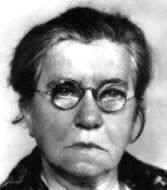 Emma Goldman |
||
| Lysander Spooner
Spooner was a Massachusetts lawyer and libertarian who turned his knowledge and vigour to combating the encroachment of the state on the liberty of the individual. Before the Civil War he wrote on the unconstitutionality of slavery; afterwards he wrote on the unconstitutionality of the constitution. His opposition to the state often took very practical forms; for example, when he was opposing the postal monopoly, he set up a private postal system which succeeded so well that, even if he did not succeed in ending the postal monopoly, he at least forced a considerable reduction in postal rates. His conceptions of democracy were so direct and participatory as to be virtually indistinguishable from anarchism. Reading from No Treason The Constitution has no inherent authority or obligation. It has no authority or obligation at all, unless as a contract between man and man. And it does not so much as even purport to be a contract between persons now existing. It purports, at most, to be only a contract between persons living eighty years ago. And it can be supposed to have been a contract then only between persons who had already come to years of discretion, so as to be competent to make reasonable and obligatory contracts. Furthermore, we know, historically, that only a small portion even of the people then existing were consulted on the subject, or asked, or permitted to express either their consent or dissent in any formal manner. Those persons, if any, who did give their consent formally, are all dead now. Most of them have been dead forty, fifty, sixty, or seventy years. And the Constitution, so far as it was their contract, died with them. They had no natural power or right to make it obligatory upon their children. It is not only plainly impossible, in the nature of things, that they could bind their posterity, but they did not even attempt to bind them. That is to say, the instrument does not purport to be an agreement between anybody but 'the people' then existing; nor does it, either expressly or impliedly, assert any right, power, or disposition, on their part, to bind anybody but themselves. Let us see. Its language is: We, the people of the United States [that is, the people then existing in the United States], in order to form a more perfect union, insure domestic tranquillity, provide for the common defense, promote the general welfare, and secure the blessings of liberty to ourselves and our prosperity, do ordain and establish this Constitution for the United States of America. It is plain, in the first place, that this language, as an agreement, purports to be only what it at most really was, viz., a contract between the people then existing; and, of necessity, binding, as a contract, only upon those then existing. In the second place, the language neither expresses nor implies that they had any intention or desire, nor that they imagined they had any right or power, to bind their 'posterity* to live under it. It does not say that their 'posterity' will, shall or must live under it. It only says, in effect, that their hopes and motives in adopting it were that it might prove useful to their posterity, as well as to themselves, by promoting their union, safety, tranquillity, liberty, etc. Suppose an agreement were entered into, in this form: We, the people of Boston, agree to maintain a fort on Governor's Island, to protect ourselves and our posterity against invasion. This agreement, as an agreement, would clearly bind nobody but the people then existing. Secondly, it would assert no right, power, or disposition, on their part, to compel their 'posterity' to maintain such a fort. It would only indicate that the supposed welfare of their posterity was one of the motives that induced the original parties to enter into an agreement. When a man says he is building a house for himself and his posterity, he does not mean to be understood as saying that he has any thought of binding them, nor is it to be inferred that he is so foolish as to imagine that he has any right or power to bind them, to live in it. So far as they are concerned, he only means to be understood as saying that his hopes and motives, in building it, are that they, or at least some of them, may find it for their happiness to live in it. So when a man says he is planting a tree for himself and his posterity, he does not mean to be understood as saying that he has any thought of compelling them, nor is it to be inferred that he 'is such a simpleton as to imagine that he has any right or power to compel them, to eat fruit. So far as they are concerned, he only means to say that his hopes and motives, in planting the tree, are that its fruit may be agreeable to them. So it was with those who originally adopted the Constitution. Whatever may have been their personal intentions, the legal meaning of their language, so far as their 'posterity' was concerned, simply was, that the hopes and motives, in entering into the agreement, were that it might promote their union, safety, tranquillity, and welfare; and that it might tend 'to secure to them the blessings of liberty'. The language does not assert nor at all imply, any right, power, or disposition, on the part of the original parties to the agreement, to compel their 'posterity' to live under it. If they had intended to bind their posterity to live under it, they should have said that their object was, not 'to secure to them the blessings of liberty', but to make slaves of them; for if their 'posterity' are bound to live under it, they are nothing less than the slaves of their foolish, tyrannical, and dead grandfathers. It cannot be said that the Constitution formed 'the people of the United States', for all time, into a corporation. It does not speak of 'the people* as a corporation, but as individuals. A corporation does not describe itself as 'we', nor as 'people', nor as 'ourselves'. Nor does a corporation, in legal language, have any 'posterity'. It supposes itself to have, and speaks of itself as having, perpetual existence, as a single individuality. Moreover, no body of men, existing at any one time, have the power to create a perpetual corporation. A corporation can become practically perpetual only by the voluntary accession of new members, as the old ones die off. But for this voluntary accession of new members, the corporation necessarily dies with the death of those who originally composed it Legally speaking, therefore, there is, in the Constitution, nothing that professes or attempts to bind the 'posterity' of those who established it... The Constitution itself, then, being of no authority, on what authority does our government practically rest? On what ground can those who pretend to administer it, claim the right to seize men's property, to restrain them in their natural liberty of action, industry and trade, and to kill all those who deny their authority to dispose of men's properties, liberties and lives at their pleasure or discretion? The most they can say, in answer to this question, is, that some half, two-thirds, or three-quarters, of the male adults of the country have a tacit understanding that they will maintain a government under the Constitution; that they will select, by ballot, the persons to administer it; and that those persons who may receive a majority, or a plurality, of their ballots, shall act as their representatives, and administer the Constitution in their name, and by their authority. But this tacit understanding (admitting it to exist) cannot at all justify the conclusion drawn from it. A tacit understanding between A, B, and C, that they will, by ballot, depute D as their agent, to deprive me of my property, liberty, or life, cannot at all authorize D to do so. He is none the less a robber, tyrant, and murderer, because he claims to act as their agent, than he would be if he avowedly acted on his own responsibility alone. Neither am I bound to recognize him as their agent, nor can he legitimately claim to be their agent, when he brings no written authority from them accrediting him as such. I am under no obligation to take his word as to who his principals may be, or whether he has any. Bringing no credentials, I have a right to say he has no such authority even as he claims to have; and that he is therefore intending to rob, enslave or murder me on his own account. This tacit understanding, therefore, among the voters of the country, amounts to nothing as an authority to their agents. Neither do the ballots by which they select their agents, avail any more than does their tacit understanding; for their ballots are given in secret, and therefore in a way to avoid any personal responsibility for the acts of their agents. No body of men can be said to authorize a man to act as their agent, to the injury of a third person, unless they do it in so open and authentic a manner as to make themselves personally responsible for his acts. None of the voters in this country appoint their political agents in any open, authentic manner, or in any manner to make themselves responsible for their acts. Therefore these pretended agents cannot legitimately claim to be really agents. Somebody must be responsible for the acts of these pretended agents; and if they cannot show any open and authentic credentials from their principals, they cannot, by law or reason, be said to have any principals. The maxim applies here, that what does not appear, does not exist. If they can show no principals, they have none. But even these pretended agents do not themselves know who their pretended principals are. These latter act in secret; for acting by secret ballot is acting in secret as much as if they were to meet in secret conclave in the darkness of the night. And they are personally as much unknown to the agents they select, as they are to others. No pretended agent therefore can ever know by whose ballot he is selected, or consequently who his real principals are. Not knowing who his principals are, he has no right to say that he has any. He can, at most, say only that he is the agent of a secret band of robbers and murderers, who are bound by that faith which prevails among confederates in crime, to stand by him, if his acts, done in their name, shall be resisted. Men honestly engaged in attempting to establish justice in the world, have no occasion thus to act in secret; or to appoint agents for which they (the principals) are not willing to be responsible. The secret ballot makes a secret government; and a secret government is a secret band of robbers and murderers. Open despotism is better than this. The single despot stands out in the fact of all men, and says, I am the State: My will is law; I am your master: I take the responsibility of my acts: The only arbiter I acknowledge is the sword: If anyone denies my right, let him try conclusions with me. But a secret government is little less than a government of assassins. Under it, a man knows not who his tyrants are, until they have struck, and perhaps not then. He may guess, beforehand, as to some of his immediate neighbours. But he really knows nothing. The man to whom he would most naturally fly for protection, may prove an enemy, when the time of trial comes. This is the kind of government we have; and it is the only one we are likely to have, until men are ready to say: We will consent to no Constitution, except such a one as we are neither ashamed nor afraid to sign; and we will authorize no government to do anything in our name which we are not willing to be personally responsible. |
||
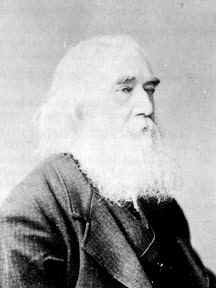 Lysander Spooner |
||
| Marguerite Porete
Biography Marguerite Porete was born at Hainaut, became a Beguine, and wrote Le Miroir des simples âmes sometimebetween 1296 and 1306. Her book takes the form of verse and commentary forming a dialogue between Love, Reason, and the Soul. It suggests that the individual moves through seven stages (a kind of spiritual Maslowian development) of spiritual growth as it develops toward union with God. For the mystic, such development takes precedence over worldly concerns, and is sufficient reason to follow spiritual priorities. At the fourth stage, for instance, the soul is at "a level of contemplation in which it is free of all obedience to eternal authority and laws. At the seventh stage the soul arrives at level of 'glorification' in which 'all the works of virtue are enclosed in the soul and obey her without contradiction.' Porete goes on to argue that in this stage the soul need not concern itself with masses, penance, sermons, fasts or prayer. Reading from The Mirror of Simple Souls Love: Now, Reason, says Love, you have heard something about these three deaths by which one comes to these three lives. Now I will tell you who it is who is seated on the mountain above the winds and the rain. They are those who, on earth, have neither shame nor honour, nor fear on account of something which might happen. Such folk, says Love, are secure, and so their doors are open, and yet nothing can disturb them, and no work of charity dares to penetrate. Such folk are seated on the mountain, and none other than those are seated there. Reason: Ah, for the sake of God, Lady Love, says Reason, tell us what will become of Modesty, who is the most beautiful daughter which Humility has; and Fear also, who has done for this Soul so many benefits and so many lovely services, and even myself, says Reason, who has never slept while these Virtues had need of me. Alas! says Reason, are we to be set outside of her resting place now, because she is thus arrived into lordship? Love: Not at all, says Love, since you three will remain in her entourage, and you three will be the guardians of her gate in case someone who would be against Love, to whom each of you is pledged, might want to attack her lodging. You will show loyalty only in this, that you be as gates, for otherwise havoc would be created by you. Thus you will be heard only in this, for otherwise she could sink low in need or necessity. Such a creature, says Love, is better vested by the divine life, of which we have spoken, than she is in her own spirit, which was placed in her body in its creation. And her body is better vested by her spirit than the spirit is by her body, for the grossness of the body is taken away and diminished by divine works. Thus it is better that the Soul be in the sweet country of understanding, nothing, where she loves, than she is in her own country in which she gives life. And the freeness of Love has such power. |
||
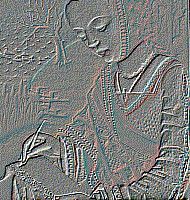 Marguerite Porete |
||